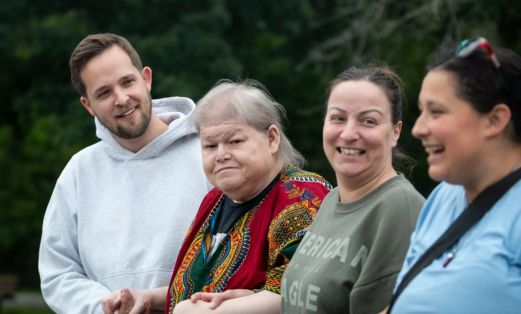
Kelsey Sobiak has become an expert on navigating life with a disability. Not because she wanted to, but because it’s a skill set that’s required if you’re someone who needs extra supports to live a full and happy life. “People with disabilities feel limited because we hear the word ‘can’t’ a lot,” she shares. “But we don’t have to let people limit us; we can do and be anything we choose.”
Sobiak, along with a group of self-advocates, has informed an important new website: MyRightsMatter.ca. Created by St.Amant and led by those with first-hand experience of disability, the new site explores many topics such as rights and responsibility, making choices, the law, and choosing support services.

“MyRightsMatter is a response to decades of people with disabilities being treated as second-class citizens,” explains Branden DeFoort, project coordinator. “Self-advocates and their allies have long been asking for a resource to help people better understand their rights, especially after many have spent a lifetime being told they don’t the right to determine things for themselves.”
That’s the cornerstone of what motivates Sobiak to advocate for people with disabilities. “We are the drivers of our own lives, and the people around us should know that,” she explains. “So it starts with us; we have to understand what our rights are, and we want the real information, nothing diluted. The website doesn’t sugar coat anything. It’s just a great place to get the facts and educate yourself.”
Sobiak, who also delivers disability support workshops with organizations such as Epic Opportunities, has been proud to participate in shaping the website, and appreciates that feedback was used to guide the look and feel of the project. “There is so much information to cover when it comes to our rights and it can be overwhelming,” she continues. “A lot of people with disabilities also have difficulty getting transportation to go to training, so having a website where we can learn at our own pace, from our own homes, makes a big difference.”
While the site was designed by and for people with disabilities, Sobiak points out that it’s a good source of information for anyone. “Staff who work with people with disabilities should visit this site, too,” she says. “The social service system was built to have staff do everything for us, and to make decisions for us, and I think if they saw the website and better understood our rights, maybe they would be able to better support us.”
MyRightsMatter.ca offers a lot of information on the rights of people with disabilities, but it goes beyond that to help the content really come to life. Each module includes the reflections of someone with lived experience; questions to help the reader engage more deeply with the content, and final thoughts to bring it all together.
That approach is rooted in the work of the self-advocates behind the project, who set out to create a resource shaped by lived experience and real needs. “The website is designed to support people in reclaiming their rightful place as full citizens,” concludes DeFoort. “It’s been so amazing to work alongside this group, who took things into their own hands and created something powerful and meaningful. Learning about your rights is not a one-time conversation, and this work is just getting started.”