
When Gladys Hrabi began her role as Executive Director of the Catholic Health Association of Manitoba (CHAM) in 2024, she was immediately struck by an open file: addressing social exclusion and isolation in older adults. “I wanted to start my time here by working on an issue where we could quickly start to make a difference,” she explains. “We’ve already launched a few programs and when a funding opportunity came up for intergenerational connections, we knew it was a great fit for what we’re trying to achieve: helping seniors combat loneliness.”
With financial support from New Horizons for Seniors and the assistance of her colleague Rachel Neufeld, social worker and project coordinator, Hrabi began developing a project that would provide a way for seniors and youth to get to know each other. To do this, they started by putting together an advisory group of four volunteers from each age range.
One of the first things the advisory group shared was that neither age bracket wanted to be passive. Students specifically said they wanted interaction and the chance to get to know the elderly; a common interest would be a great jumping off point. The group chose music as the first theme to plan an event around.
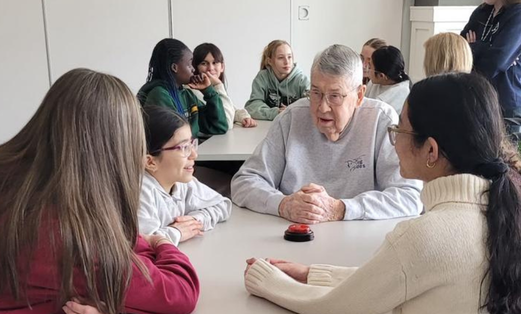
By connecting a few long term care facilities like Actionmarguerite, Résidence Despins, Misericordia Terrace and Holy Family Personal Care Home with students from Catholic schools across the city, a group of 35 seniors and 25 youth spent an evening together in December, and again earlier this month.
“We had sing-alongs, dancing, people were talking about music and sharing stories,” shares Neufeld. “Just like every social gathering, some folks were eager and had lots to say. Others were a little more unsure of how to proceed, but that’s part of the getting to know each other and growing together. That’s how we build community.”
Hrabi is heartened by the conversations she’s heard at the advisory committee and during the events. “The youth might think that a senior wouldn’t understand them or what they’re going through,” she shares. “But they do! Some issues we are facing can be very similar, no matter our age. Just because seniors are all grown up doesn’t mean they have the answers, but they do have experiences to share. It’s been amazing to watch misconceptions fall away as they get to know each other.”
While confronting biases and showing curiosity is great for reducing isolation, making connections and creating bonds at gatherings also brings a lot of laughter to both groups. “We played music during the event, and while we were chatting, a 75-year-old man mentioned that it was a new Taylor Swift song,” Hrabi recalls with a smile. “The youth had no idea whose song it was! We also had a student who thought that some of the older members of the group had fought in World War II, which was not the case for most of them, who were a decade or even two too young to have participated… There’s been lots of myth-busting, that’s for sure!”
For her part, Neufeld has an easy indicator of success for the gatherings: “I had backup plans in my head for what to do if people weren’t engaging, but that isn’t what happened,” she explains. “I thought we’d have to focus on activities and encourage folks to interact, but instead I had to interrupt a few conversations to move us along and do all the planned activities. I almost felt bad for having to intervene!”
While the friendly and fun interactions between generations are rolling along, funding for this initiative will be time limited under the leadership of CHAM. Hrabi isn’t discouraged and believes this is just the beginning. “We’ve started connecting these groups of people and we hope it’s something that will spread,” she shares. “I’ve had people ask me if they can continue to meet after funding ends in March, and that makes me so happy. This kind of joy and connection is possible for us all, if we can find the right place to engage in it.”