
Vitalité santé! Road Map
This road map outlines the components of the project that will be moving forward simultaneously for the duration of Vitalité santé!, from 2023 to 2028.
Each project component is approached through the lens of maintaining and strengthening partnerships and strengthening Francophone presence in Manitoba’s health and social services.
Click the image below to see the full road map, or scroll to explore the details behind each component.
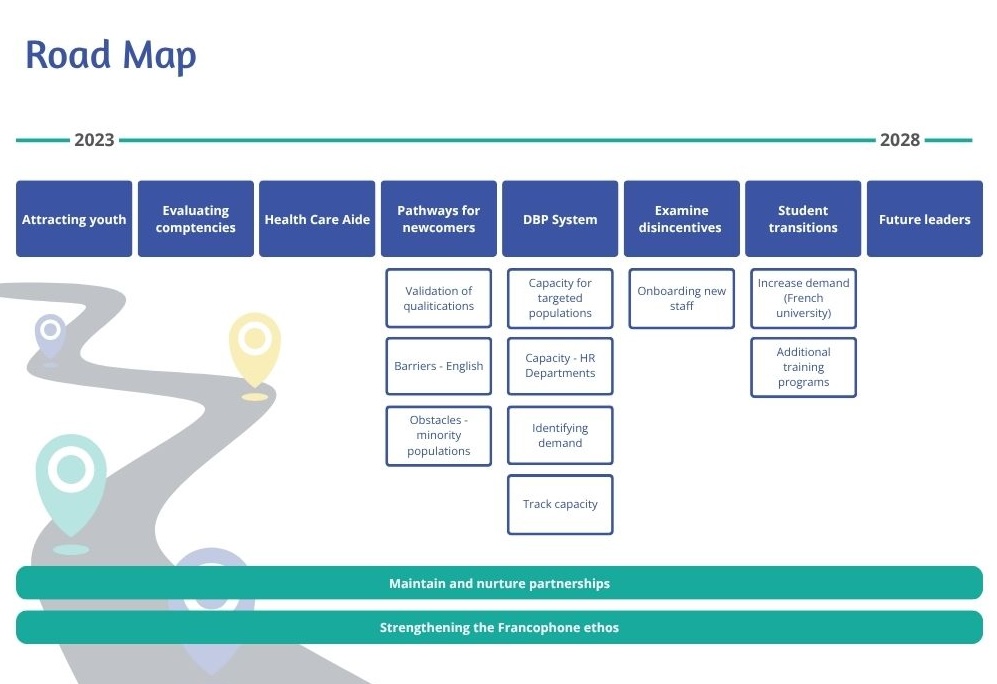
If youth do not view health and social services as attractive career options, there is no long-term potential to address human resource challenges. We will explore what more we can do to encourage bilingual youth to pursue a career in health and social services that serve the Francophone population.
In Manitoba, there is not a standardized test that is used by everyone. The French language evaluation process is not consistent across the province. This situation creates a burden for bilingual staff who must undergo multiple tests when they are transferred to other positions within the system. The current process is considered intimidating and time-consuming. We will explore how we can simplify this process and reduce barriers to french language testing.
The lack of bilingual health care aides was identified by HR data and initial discussions with Vitalité santé! stakeholders. The topic is complex and touches on certified and non-certified health care aides, youth and newcomer participation, while taking into account that these positions cannot remain vacant until a bilingual incumbent is found. We will explore ways that the system can increase the number of bilingual health care aides, especially in the sectors caring for the elderly.
Understanding and navigating the process of entering the labour market is challenging, especially for the newcomer population who also have to deal with a new language and culture. The process is confusing, expensive, and time-consuming. We need to explore options to improve the situation considering and also explore the specific challenges below.
Review the qualification validation process
For bilingual professionals interested in practising in Manitoba, there may be a lengthy process to validate their qualifications so that they can work in the province. The requirements and related processes (and therefore the complexity) vary by profession.
Addressing English barriers
Individuals who speak French as a strong official language must demonstrate a certain level of English in health and social services in Manitoba. Proficiency in English is also required to undertake university-level studies. Time, cost, and availability of courses and support are associated challenges.
Addressing the challenges faced by employees representing minority cultures
Both employers and staff report the pervasiveness of work-related challenges in health and social services. People from minority cultures report experiencing incidents of racism, discrimination, and general lack of acceptance by patients, residents, clients, and other staff.
The approach used to designate positions has not proven to be as effective as it should be. There are many factors that need to be considered to have an effective system, such as HR software, reporting capabilities, flexibility, union restrictions, and monitoring capabilities. It is believed that changes could be made to improve the current system. The areas below are among the challenges the improvements will consider.
Study service capacity for targeted population
Some populations are particularly vulnerable if services are not available in French. Should each of these populations be examined and determine if there are core services and programs available to support them with sufficient bilingual capacity?
Identifying the demand for French-language services
It is not easy to know the demand for services by the Francophone population. Programs, sites and services may not ask the question about preferred official language of the client, resident or patient, or may not ask it consistently.
Examine insufficient capacity in HR Departments
Some bilingual and Francophone organizations have bilingual human resources staff, but there are no known bilingual HR professionals within regional service delivery organizations (service delivery organizations, e.g., WRHA, Southern Health-Santé Sud, CancerCare, etc.). If HR staff do not understand and support their colleagues at this core level, improvements will be greatly tested.
Track and monitor capacity to provide services
The current capacity of bilingual service delivery is not fully known. There are two main sources of information. For positions designated bilingual, the responsible managers indicate whether these positions are currently occupied by bilingual incumbents. We also know that there are bilingual employees who occupy positions that are not designated bilingual. This additional capacity is not consistently recorded.
Employees consistently identify real or perceived barriers to occupying a designated bilingual position. The factors are numerous and include the lack of incentives, the requirement for language assessment, perceptions from peers and leaders, and workload among others. We will explore potential disincentives and how to address them with employees who have direct experience. We will also consider how to address disincentives in the processes of onboarding and mentorship.
Ongoarding and mentorship of new staff
New staff have a lot to learn and absorb in the first few days and months of their tenure. Bilingual staff may need even more support as they face the additional challenges of delivering French-language services with the policies, practices and challenges that may come with this responsibility.
Bilingual university students often do not know where they could work in French after graduation. The process of finding employment options is often difficult. We will explore ways to help ensure our bilingual students find opportunities at sites or programs that support the Francophone community and expose them to the value of their french language skills. In addition, the project will support the universities in the priorities below.
Increase the demand for university programs in French
We must maximize the number of students who study in French and who will eventually work in the Manitoba system serving Francophones.
Identify additional training programs (in French)
Not all career options are available in French. Are there other programs that could be expanded locally to meet the human resource needs we face?
Directors and other bilingual leaders bring specific knowledge and experience to their decision-making roles, that is, a good understanding of Francophone legislation, the needs of the population and the importance of providing bilingual services. In the absence of an approach to identify, support and train future bilingual leaders, the level of understanding of the issues by companies is likely to be further weakened in the years to come. We will work together with a group of current and future leaders to come up with ways to ensure strong francophone leadership devoted to maintaining biingual services well into the future.