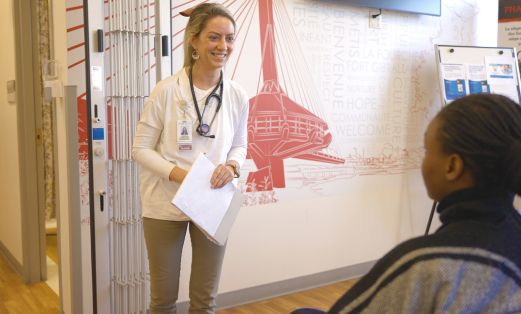
A harm reduction training program at Centre de santé Saint-Boniface (CDS) is broadening the horizons of staff, changing the dialogue around supporting patients, and most importantly, creating a safer space for patients to talk about some of their most challenging issues. Beyond the Needle, a three-day program offered by the Manitoba Harm Reduction Network, has been a gamechanger for all involved.
Dr. Melodie Vermette, who has been a physician with CDS for close to two years, attended the training and was grateful for her learnings. “It was a good recap of things we know but maybe needed to think of in a different way,” she shares. “They wanted us to list the benefits of using substances, which of course is a challenge to our way of thinking. But we came up with 30 or 40 reasons, when we normally think that substances are only bad. We talked a lot about those root causes and realities.”
That activity had an immediate impact on how Dr. Vermette will approach substances with her patients. “I used to ask patients if they thought their usage was a problem, or if they wanted to be using those substances,” she explains. “Those were the wrong questions if I wanted someone to feel safe and non-judged. Why do you use? How does it benefit you? The answers to these questions will allow me to better understand where they’re coming from and how I can help.”

Janelle Delorme, Manager of Indigenous Relations & Equity, Diversity and Inclusion at CDS, shares that the chance for staff to attend this training together was important, but also a long time coming. “It’s a process and evolution, when you are trying to shift the way you approach patients or situations,” she shares. “Over the last three years, we have slowly grown in our knowledge together, we’ve learned about trauma-informed care, we have new connections with the organization Street Connections, we had many pieces of this in place, so our whole team was ready for a deep dive like the one we had with Beyond the Needle.”
For Delorme, one of the most powerful activities was when the group looked at the life of a person on Employment and Income Assistance (EIA). They broke down that person’s budget, logistics and real-life barriers. “We learned about the systems that keep people trapped,” she continues. “I saw some of light bulb moments, where people suddenly realized how hard it is for some of the people we support. This training helped demystify a lot of things that we’ve learned, intentionally or unintentionally, from society. And we owe it to our community to keep learning.”
Harm reduction is a term that is often debated in recent years, but Delorme believes harm reduction is a straight line to better care. “We know we can have more compassion for the person in front of us, and breaking down stigmas and bias is one of the ways we do that,” she continues. “We have patients who have said to us, ‘I don’t know what to do when someone is nice to me,’ because they have never felt accepted or welcomed in health care spaces before. We can do better and we owe it to our communities to do better.”
The staff at CDS are feeling empowered and uplifted by their new perspectives on harm reduction and are feeling as though they have a better understanding of the health challenges of their patients. “At the end of the day, I know this: the best care we can provide meets people’s actual needs,” Delorme concludes. “If someone doesn’t want to quit alcohol, maybe it’s because they need stable housing first. If someone doesn’t want to quit drugs, maybe they need counselling first. When patients feel safe telling us what’s happening in their lives, we can better serve them and help them get back to better health.”